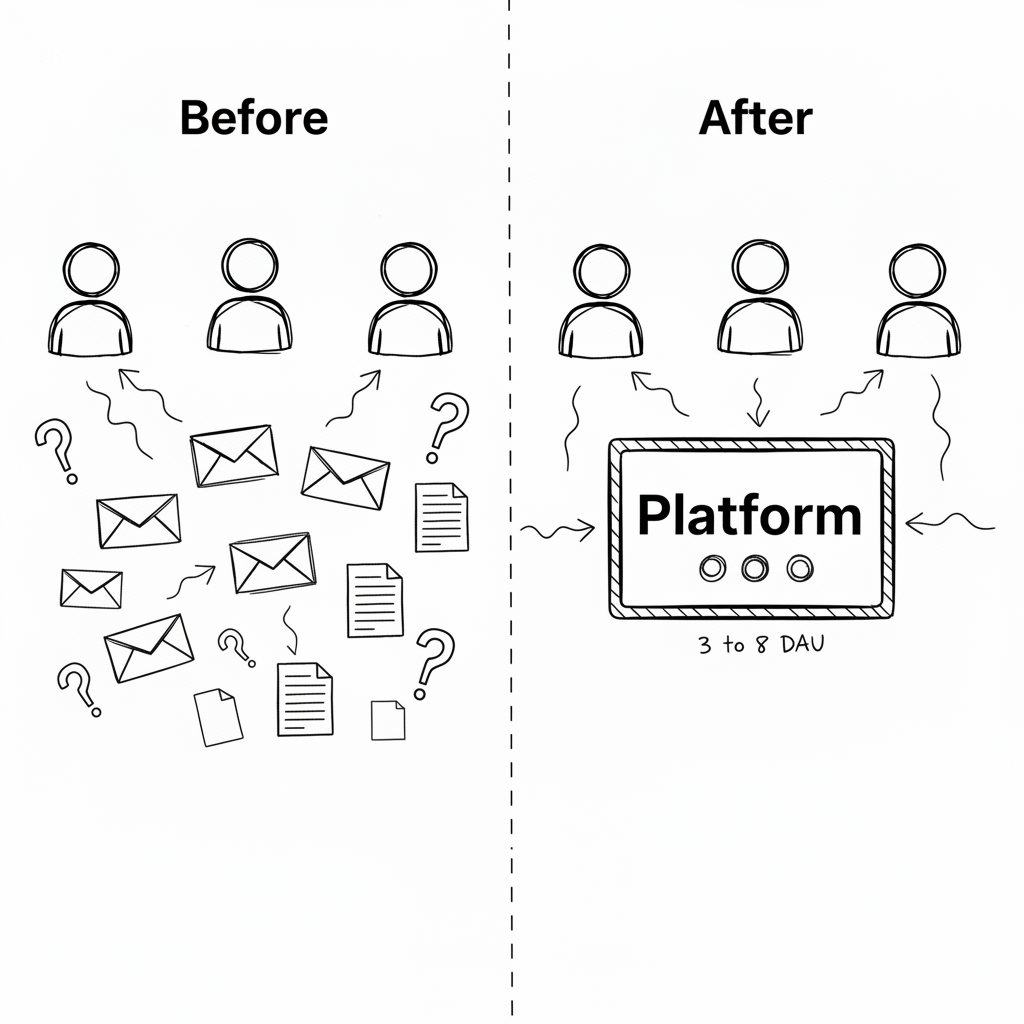
You can build the most elegant knowledge-sharing platform in the world. Perfect search. Beautiful UI. Real-time collaboration. None of it matters if people keep using email chains instead.
I spent two years as Tech Lead building an internal platform for 120 consultants. We shipped 14 microservices. We built document management, mission tracking, project collaboration tools. The tech worked flawlessly.
But the real win wasn't the architecture. It was watching consultants start answering each other's questions through the platform instead of forwarding email threads. That "community effect" wasn't planned. It became the main value driver.
The Problem: Information Silos
Enterprise consulting firms are full of experts. Every consultant has deep knowledge in their domain. But that knowledge stays locked in their heads, their email inboxes, and scattered Word documents.
When a consultant joins a new client project, they need answers fast. They email colleagues. Wait for responses. Duplicate work other consultants already did. Client response times suffer.
The technical solution is obvious: build a central knowledge repository. But the hard part isn't building it--it's getting people to use it.
What We Built
The platform had everything you'd expect from an enterprise system:
- User management and mission tracking
- Client database with project history
- Document management system
- Collaboration tools for active projects
- Python-based BI reporting pipeline
We built it as 14 Symfony microservices with a shared package for common logic. Vue frontend. PostgreSQL. Deployed on PaaS with proper monitoring and alerting.
Technically solid. But technical excellence doesn't guarantee adoption.
The Shift: From Tool to Community
Around month 8, something changed. Consultants weren't just uploading documents anymore. They were asking questions in project channels. Other consultants were jumping in to answer--even if they weren't assigned to that project.
We hadn't built a Q&A feature. We hadn't gamified participation. We just made it easy to see what colleagues were working on and jump into conversations.
"The platform stopped being a filing cabinet and started being a place where people actually helped each other. That's when daily active users jumped from 3 to 8."
Eight daily active users might sound small. But in a 120-person firm where most people are on client sites all day, that's significant. More importantly, those 8 were answering questions for the other 112.
Lessons Learned
Here's what actually mattered for building knowledge systems that get used:
- Make information visible by default. Don't bury project updates in private channels. Let people discover what others are working on.
- Optimize for quick answers, not comprehensive documentation. Consultants won't write a wiki page. But they will answer a question in 2 minutes.
- Reduce friction for helpers, not just seekers. Make it dead simple for experts to jump into a conversation and share knowledge.
- Measure community effects, not just storage metrics. "Documents uploaded" is vanity. "Questions answered by peers" is value.
- Accept that adoption is gradual. We launched to 120 users. Only ~8 were daily active. But those 8 made the platform valuable for everyone else.
The Technical Stack Mattered Too
Don't get me wrong--the architecture enabled the community effect. Here's what worked:
- Microservices let us ship features independently. When we needed better search, we didn't have to touch the mission tracking code.
- Shared package for common logic meant authentication, logging, and database patterns stayed consistent across services.
- Real-time updates in the Vue frontend made conversations feel immediate, not like refreshing email.
- Monitoring and alerting meant we caught issues before users complained. Reliability builds trust.
But the architecture only matters if people actually use the system. And they only use it if it solves a real problem better than their current workflow.
Checklist: Building Knowledge Systems That Get Used
- Make it easier than email (not just better--easier)
- Default to public/visible information sharing
- Optimize for async communication (consultants are busy)
- Show recent activity prominently (create FOMO for participation)
- Let experts surface naturally (don't force hierarchies)
- Measure time-to-answer, not storage capacity
- Accept that power users will drive adoption
- Build infrastructure that's reliable enough to trust
The best knowledge systems don't feel like systems. They feel like helpful colleagues who are always available. That's the standard to aim for.